




Are You Choosing the Right Heating Technology for Extreme Winters?
When evaluating whether your current heating system is truly prepared to handle another brutal winter, navigating the landscape of options comparisons for homeowners is often the first and most critical step. When a furnace nears the end of its functional lifespan, you are faced with an important decision. Upgrading requires more than just swapping out an old box for a new one. It requires choosing the right technology based on your specific home heating requirements and long-term energy efficiency goals. The stakes are particularly high when preparing for a deep winter freeze, where equipment failure is not just an inconvenience, but a structural risk to your home.
Making this decision means sorting through technical specifications that can often feel overwhelming. Whether you lean toward the tried-and-true reliability of combustion heating or the advanced efficiency of modern refrigerant-based systems, understanding the underlying technology is the first step. By taking an objective, technical approach to evaluating these systems, you can ensure your home remains comfortable and efficient. If you are beginning this process, consulting with experts who provide comprehensive professional HVAC and plumbing services will help you align your home's infrastructure with the right heating technology.
Understanding the Mechanics: Combustion vs. Heat Transfer
To make an informed decision between a traditional gas furnace and a cold-climate heat pump, you first need to understand how each system actually generates and distributes warmth. These two technologies operate on fundamentally different principles. One relies on creating heat through the burning of fossil fuels, while the other relies on moving existing heat from one place to another. Neither system is universally superior; their effectiveness depends entirely on your home's thermal envelope, your local climate, and your efficiency goals. To evaluate them properly, you must look beyond basic marketing claims and understand the mechanics that drive their AFUE and HSPF ratings.
The Combustion Process in Traditional Furnaces
Traditional gas furnaces are the historical standard for residential heating, particularly in regions that experience extreme cold. The process begins when the thermostat signals the furnace to turn on, opening a valve that delivers natural gas or propane to the burners. An electronic ignition system lights the fuel, creating controlled combustion inside a sealed chamber. This combustion generates intense heat, which is then transferred to a metal component known as the heat exchanger.
As the heat exchanger warms up, the system's blower motor pulls cold indoor air across the exterior of the hot metal, rapidly warming the air before forcing it through your ductwork. The toxic byproducts of the combustion process, including carbon monoxide, are safely vented out of your home through a dedicated exhaust flue. Because they generate their own heat through fuel consumption, gas furnaces are capable of producing highly consistent, extremely hot air regardless of how cold it gets outside. This raw heating power is why combustion has remained the dominant choice for extreme climates.
Advanced Heat Transfer in Modern Pumps
Unlike furnaces, cold-climate heat pumps do not generate heat by burning fuel; they use electricity to transfer thermal energy. Even when temperatures drop well below freezing, there is still ambient heat energy present in the outdoor air. A heat pump uses a closed-loop system filled with specialized chemical refrigerant to capture this heat. The outdoor unit's fan pulls freezing air across the evaporator coil, where the extremely cold liquid refrigerant absorbs the available ambient heat and turns into a gas.
This gas is then sent to a variable-speed compressor, which pressurizes the refrigerant. Compressing the gas significantly increases its temperature. This hot gas travels to the indoor unit, where the air handler blows your home's indoor air across the hot coil, warming the air before distributing it through the vents. As the heat is released, the refrigerant cools, returns to a liquid state, and cycles back outside. Modern cold-climate variants utilize advanced variable-speed compressors and enhanced refrigerants that allow them to continue extracting heat efficiently even in sub-zero conditions. If you are exploring home heating solutions, understanding this heat transfer cycle is essential for evaluating a heat pump's viability for your property.
Decoding Efficiency: What AFUE and HSPF Ratings Mean for Your Home
When comparing heating systems, the alphabet soup of efficiency ratings can quickly become confusing. To accurately gauge how well a system will perform and how much energy it will consume, you must understand the specific metrics used for each technology. Because furnaces and heat pumps operate differently, they are measured by different standards. You cannot compare them on a one-to-one basis without understanding the distinction between fuel utilization and electrical efficiency.
Understanding AFUE for Gas Furnaces:
AFUE stands for Annual Fuel Utilization Efficiency. This percentage measures a gas furnace's ability to convert fossil fuel into usable heat over the course of a typical year. For example, if a furnace has an AFUE rating of 96%, it means that 96% of the fuel consumed is successfully converted into heat for your home, while the remaining 4% is lost as exhaust gases through the flue. Modern high-efficiency furnaces typically feature AFUE ratings between 90% and 98%, utilizing secondary heat exchangers to capture condensing exhaust gases for maximum efficiency.
Understanding HSPF for Heat Pumps:
HSPF stands for Heating Seasonal Performance Factor. This metric measures the efficiency of an air source heat pump specifically during the winter heating season. It is calculated by dividing the total heating output (measured in British Thermal Units, or BTUs) by the total electricity consumed (measured in watt-hours) over the season. A higher HSPF number indicates a more efficient unit. High-efficiency cold-climate heat pumps generally feature HSPF ratings of 9.0 or higher, with some top-tier models exceeding 10.0.
Comparing the Two Metrics:
Directly comparing AFUE and HSPF ratings is complex because they measure different energy sources. AFUE measures thermal efficiency (fuel in versus heat out), which can never mathematically exceed 100%. HSPF measures the coefficient of performance for heat transfer. Because a heat pump moves heat rather than creating it, it can output more thermal energy than the electrical energy it consumes—sometimes achieving effective efficiencies of 200% to 300% in moderate weather. However, this efficiency curve changes as the temperature drops, which is why understanding both ratings is vital for winter preparation.
System Performance During a Deep Winter Freeze
The most critical concern for homeowners evaluating new technology is reliability during extreme weather. When temperatures plummet, your heating system must run continuously to maintain a safe indoor environment. Understanding the operational limits of each system during a deep winter freeze is the most important part of the decision-making process.
The Consistency of Gas Furnaces:
A traditional gas furnace is largely unaffected by dropping outdoor temperatures. Whether it is mildly chilly or severely below zero, the combustion process inside the furnace remains the same. The system will continue to output air at a consistently high temperature, typically between 120°F and 140°F at the vent. This rapid, intense heat delivery is excellent for quickly warming a cold house and recovering from nighttime temperature setbacks.
The Realities of Cold-Climate Heat Pumps:
In our years installing and servicing equipment across the region, the team at Niagara Home Heating has seen firsthand how Niagara Falls winter conditions present a unique challenge. The combination of sustained freezing temperatures, high humidity, and lake-effect weather means outdoor equipment is subjected to heavy frost accumulation. As a heat pump extracts heat from the freezing, humid air, condensation forms on the outdoor coil and immediately turns to ice. To continue functioning, the heat pump must periodically enter a "defrost cycle." During this cycle, the system temporarily reverses its operation, using heat from the home to melt the ice on the outdoor unit. While modern cold-climate heat pumps are engineered to handle this efficiently, the air delivered through the vents during extreme cold is generally cooler than a furnace (often around 90°F to 100°F). It provides a slow, steady warmth rather than a rapid blast of hot air.
The Dual-Fuel Solution:
For homeowners who want the high-efficiency electrical performance of a heat pump but the raw power of a furnace during a deep winter freeze, a dual-fuel (or hybrid) system is an excellent compromise. In fact, our team frequently recommends this setup to local families. This configuration pairs a cold-climate heat pump with a traditional gas furnace. The heat pump handles all the heating needs during mild and moderately cold weather. When the temperature drops below a specific economic balance point—where the heat pump loses its efficiency advantage—the system automatically shuts off the heat pump and activates the gas furnace. This ensures optimal efficiency without sacrificing comfort during the harshest weather.
Side-by-Side Comparison of Modern Heating Technologies
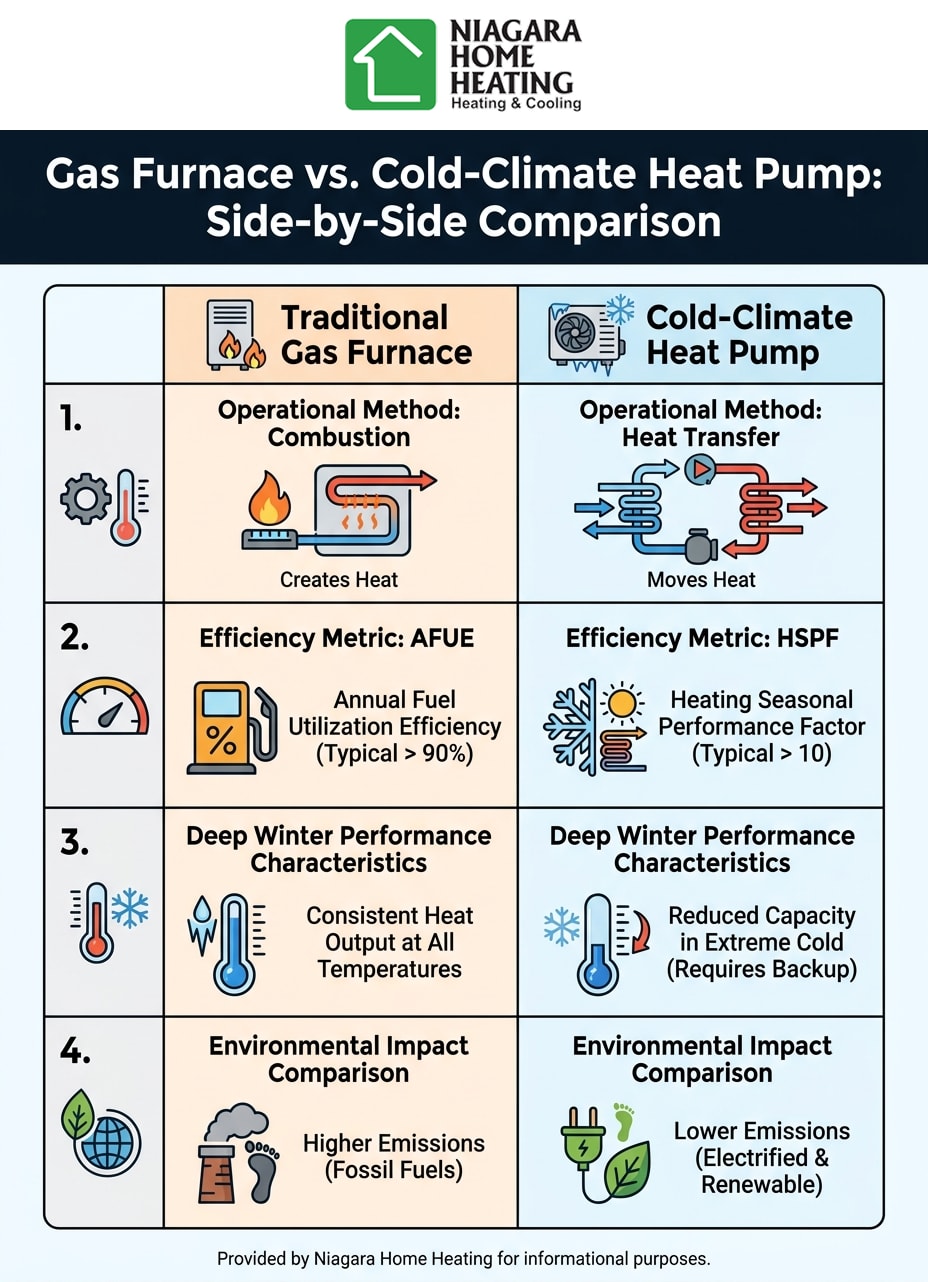
To help synthesize these technical details, it is helpful to view the core differences side-by-side. Both systems have distinct advantages and specific maintenance requirements that will impact your home comfort experience over the next 15 to 20 years. Reviewing these factors against your specific AFUE and HSPF ratings goals will clarify which path is right for your property.
• Operational Method — Traditional Gas Furnace: Combustion of fossil fuels (natural gas or propane). — Cold-Climate Heat Pump: Transfer of ambient heat using electricity and refrigerant.
• Efficiency Metric — Traditional Gas Furnace: AFUE (Maximum 98% efficiency). — Cold-Climate Heat Pump: HSPF (Can exceed 100% effective efficiency in moderate cold).
• Deep Winter Performance — Traditional Gas Furnace: Consistent, rapid, high-temperature heat regardless of outdoor weather. — Cold-Climate Heat Pump: Steady, lower-temperature heat; requires periodic defrost cycles in freezing humidity.
• Maintenance Needs — Traditional Gas Furnace: Annual safety checks of heat exchangers, burners, and venting to prevent carbon monoxide leaks. — Cold-Climate Heat Pump: Bi-annual checks of refrigerant levels, compressor health, and outdoor coil clearance.
• Best Home Profile — Traditional Gas Furnace: Homes with existing gas lines, poor insulation, or extreme cold weather exposure. — Cold-Climate Heat Pump: Homes with excellent insulation, solar integration, or those seeking to reduce fossil fuel dependence.
As the table illustrates, upfront installation complexity and long-term operational efficiency vary wildly between the two. A gas furnace requires secure venting and gas line infrastructure, while a heat pump requires careful refrigerant charging and electrical upgrades. Lifespan expectations for both systems sit comfortably in the 15-year range, provided they receive meticulous, professional maintenance to manage typical wear-and-tear factors like blower motor fatigue and compressor strain.
How Central Heating Upgrades Impact Boilers and Water Heaters
Upgrading a central heating system is rarely an isolated event. Your home's mechanical room operates as an interconnected ecosystem. When you make a major change to your space heating technology, it is the ideal time to evaluate your other home comfort equipment to ensure compatibility and overall efficiency. Focusing solely on forced air while ignoring your home's water heating infrastructure can lead to missed opportunities for whole-home optimization.
Assessing Your Domestic Hot Water Needs
For homes that utilize hydronic heating—where a central boiler distributes hot water or steam through radiators or in-floor tubing—the upgrade path looks very different than for homes with forced-air ductwork. Boilers operate on an entirely different set of principles, and replacing them requires specific expertise in fluid dynamics and pressure management. If your home relies on radiant heat, you must ensure that any new equipment integrates properly with your existing piping and zone valves. Professional boiler maintenance and repair is critical before attempting to integrate new high-efficiency technology into an older hydronic system.
Furthermore, high-efficiency heat pumps and condensing furnaces can sometimes be integrated with modern water heating solutions. For instance, indirect water heaters can utilize the primary boiler's heat to generate domestic hot water, while heat pump water heaters use the same refrigerant technology as space heating to warm your shower water efficiently. Consistent hot water is just as critical as space heating during a deep winter freeze. If your current water heater is showing signs of rust, slow recovery times, or inconsistent temperatures, having a professional assess the entire HVAC and plumbing ecosystem at once ensures that your new equipment will work harmoniously without overloading your electrical panel or gas meter.
Navigating Generic Rebates and Energy Incentives
One of the primary drivers for homeowners upgrading to high-efficiency heating systems is the potential to offset initial installation costs through energy incentives. Governments and utility companies frequently encourage the adoption of greener, more efficient technologies by offering generic rebates and tax credits. While these programs can make advanced systems more accessible, navigating them requires careful attention to technical specifications.
To approach energy incentives effectively, consider these steps:
1. Verify Efficiency Requirements: Utility incentive programs are usually strictly tied to specific AFUE and HSPF ratings. A standard-efficiency unit will rarely qualify. You must ensure the exact model you select meets the minimum efficiency thresholds set by the program administrators.
2. Check Equipment Certifications: Many generic rebates require the equipment to carry specific energy certifications (such as ENERGY STAR) or be classified specifically as a cold-climate heat pump by regulatory bodies.
3. Consult Local Authorities: Rebate availability fluctuates based on municipal budgets, provincial guidelines, and federal tax laws. Always consult with your local utility provider or a qualified tax professional to verify current, applicable programs before making a purchase.
4. Prioritize Reliability Over Incentives: While incentives lower the barrier to entry, your primary focus should always remain on system reliability. Do not purchase an undersized or inappropriate system simply because it qualifies for a rebate.
Additionally, keeping your existing plumbing and heating systems in top condition can sometimes prevent the need for premature replacements. Knowing how to identify and fix water heater leaks or recognize early signs of furnace failure allows you to plan your upgrades strategically, giving you ample time to research and apply for applicable incentives without the pressure of an emergency breakdown.
Ready to Evaluate Your Home's Heating and Hot Water Needs?
The choice between a traditional gas furnace and a cold-climate heat pump ultimately depends heavily on your home's specific infrastructure, your local climate, and your long-term efficiency goals. While furnaces offer the brute force necessary to easily conquer a deep winter freeze, modern heat pumps provide exceptional efficiency and a reduced carbon footprint. Reaching the right conclusion requires a thorough, side-by-side technical comparison tailored to your property's unique thermal envelope.
Rather than guessing which technology will serve you best, we encourage homeowners to seek an objective professional assessment. As a trusted local business offering fast, reliable service, we are committed to ensuring our community is never left without essential heat or hot water during the coldest months. Whether you need a comprehensive evaluation of your heating options or require prompt water heater repair services to keep your current systems running smoothly, a professional consultation is the most reliable way to secure your home's comfort for the winter ahead.


Customer Testimonials

Very efficient company. I needed an old solar water heater removed from my roof. They were quick to book an appointment for the next day after I sent photos. They were very knowledgeable of the issue. The 2 guys that came were friendly and competent with the job, including removal of all parts.

I have used Niagara Home heating for multiple projects for over 16 years. John and his staff are absolutely the best. I tell all my friends and family about Niagara Home Heating because you won’t get any better service or pricing anywhere in Niagara. He has saved me thousands and thousands of dollars and has never let me down.
I called John today at 2:pm as my AC was not working and I wasn’t expecting even a call back as I knew with this hot weather we have had he would be swamped with calls. Well he called me back and showed at 8:pm on the same day to fix my AC. That is just incredible service and how much John really cares about his clients. Thank you John !
Lifesavers!! The AC in our house decided to quit the day we were passing the keys to the new owners!! Instead of making a service call to the house, John coached me through the minor repair over the phone, saving me the money and time waiting for a repair person to come.Much appreciated! Thanks again John
I had an issue with my hot water tank and called Niagara Home Heating. Their service was fantastic and reasonably priced—exactly how a business should be run!
We had an amazing experience getting our new furnace installed with Niagara Home Heating. The owner was very helpful, their quote was more then competitive and the technician who installed the unit was professional and friendly. I would recommend their services.

Service Areas
Our service areas encompass a wide range of locations, ensuring that we can meet the needs of our clients wherever they are. From bustling urban centers to serene rural landscapes, we are committed to providing top-notch services tailored to each unique environment.